In civil construction, precision and safety are decisive factors for the success of any project. When we talk about horizontal structures, such as slabs and beams, a fundamental system comes into play: formwork.
Why do we talk about formwork and not just shoring?
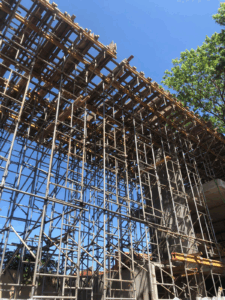
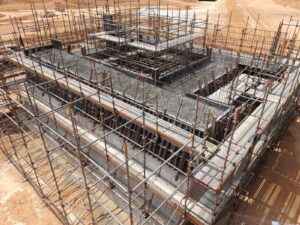
We use the term “formwork” instead of “shoring” because we understand it to be more comprehensive. While shoring refers specifically to the struts that support vertical loads, formwork encompasses the entire temporary structural assembly—including supports, joists, stringers, joists, bracing, and accessories.
Therefore, formwork represents the complete temporary support system, ensuring formwork stability and safety during the construction process.
What is Formwork?
Formwork is a temporary structure made up of different elements that work together to support horizontal formwork until the concrete reaches sufficient strength to stand on its own.
It is divided into three main groups:
Support: struts, towers, and other vertical elements.
Frame: main beams (stringers) and secondary beams (joists).
Accessories: parts that connect, adjust, and position the previous elements.
Their sizing takes into account factors such as the transferred load, the building’s ceiling height, and the strength of the material used (wood or metal).
Re-shoring: the next step
After concreting, the concrete hardening process begins. In approximately 72 hours, the piece can be considered self-supporting, but it only reaches design strength after 28 days.
To free up the formwork pieces and reuse them in other stages of the project, re-shoring is applied: part of the struts are kept for support, while the rest of the system is dismantled and reused. This ensures efficiency, savings, and safety.
Formwork vs. Shoring: Understanding the Difference
Although often used synonymously, the terms have clear differences:
Formwork
Function: The system that supports the formwork and shapes the concrete.
Components: Includes shoring, frames, bracing, and diagonals.
Purpose: Provides shape and stability to structures until the concrete reaches the required strength.
Shoring
Function: Supports vertical loads.
Components: Wooden or metal props.
Purpose: Keeps the formwork stable during the initial curing of the concrete.
In short: All shoring is part of formwork, but not all formwork is limited to shoring.
The correct use of formwork is essential to ensure safer, more productive, and more economical construction. By adopting this broader term, we reinforce the importance of understanding the system as a whole—and not just its isolated parts.
SH offers a complete portfolio of formwork, scaffolding, shoring, and formwork, ensuring the innovation, productivity, and reliability your construction site needs.
SH, THE SUPPORT YOUR PROJECT NEEDS!